
How couples and families can manage money together: 3 approaches and a 15-minute monthly check-in
This article shares general money-management ideas. It isn't personalized financial, tax or legal advice.
The short version: couples tend to manage money in one of three ways — fully joint, a joint account plus personal spending, or fully separate. None is always best. But whichever you choose, what matters is that you both see the same big picture: what the household owns, what it owes, and which way it’s heading. You don’t need to report every coffee to each other.
Three common approaches
| Approach | How it works | Good for | Common friction |
|---|---|---|---|
| Fully joint | All income goes into one account that pays for everything and saves for everything | Big income gap, shared goals, high trust | Do personal purchases need sign-off? One partner may feel a loss of independence |
| Joint account + personal spending | Each partner moves a set amount (or a share of income) into a joint account for bills and savings; the rest is theirs | Most dual-income households | What’s a fair contribution? Who manages the joint account? |
| Fully separate + split costs | Each manages their own money and splits shared bills | Newly living together, or bringing existing assets or debts | No one sees the full picture, so big goals (a home, retirement) are hard to plan together |
Many families switch approaches as life changes — separate at first, then a joint account after buying a home or having kids.
Look at more than bank balances
Looking only at savings balances can give you the wrong idea about where you stand. When you look together, include:
- Debts: how much principal is left on the mortgage and for how long; car loans, card installments
- Investments: stocks, ETFs, funds, crypto — ideally with cost basis, so you know what’s actually up or down
- Insurance: which policies, premiums, beneficiaries
- Emergency fund: how many months of living costs it covers (3–6 months is a common rule of thumb)
- Family members’ accounts: savings for the kids, accounts you help your parents manage
- Net worth: assets minus debts — the single best number for “are we moving forward?”
A 15-minute monthly money check-in
Keep it informal. Pick a regular time (say, the weekend after payday) and spend 15 minutes together:
- Is net worth up or down from last month? Why? (Markets, mortgage principal paid down, a big expense)
- Any big expenses this month, or coming up next month?
- Is the emergency fund still enough?
- Progress on goals: down payment, kids’ education, retirement
- What should change? Automatic investments, insurance, paying down debt early
The point is to look at the same numbers together — not to audit who spent what.
Together doesn’t mean everything
Keeping some personal space is healthy — a private stash, your own investments, a little fun money. A good balance: look at the household’s big items together, and decide for yourself what personal accounts to share.
That’s how family sharing works in HoldingsNest: in one shared ledger, you decide account by account whether each family member can see it.
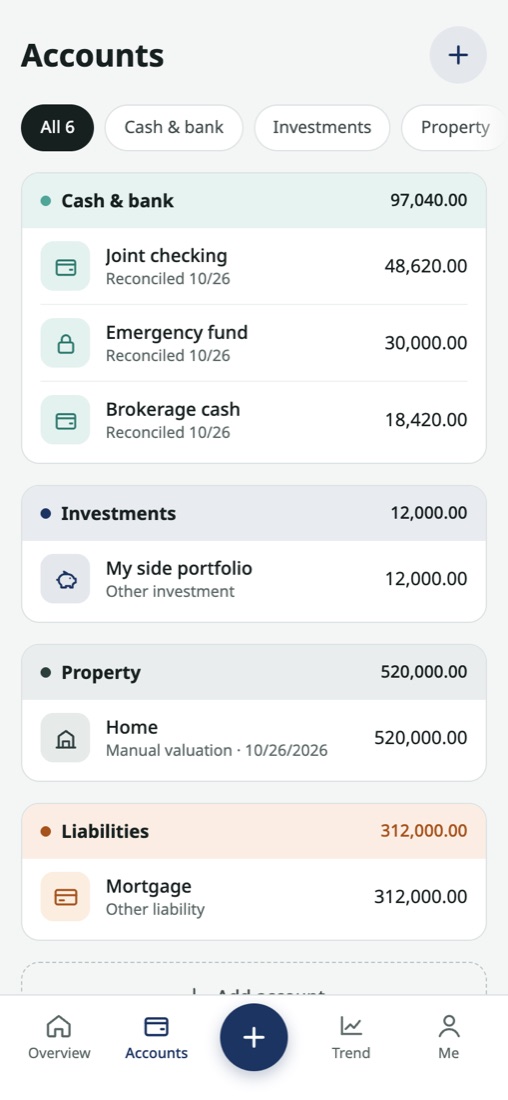
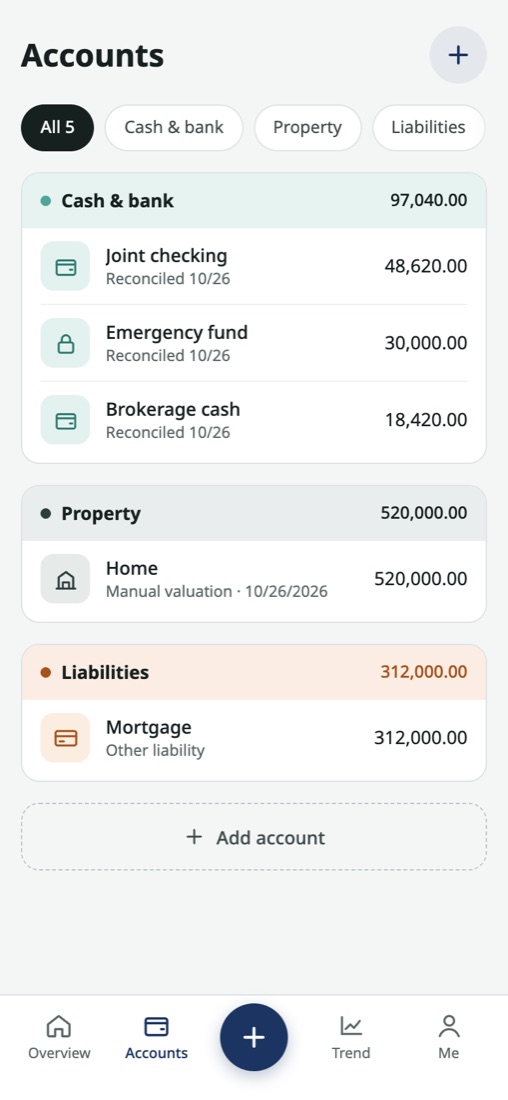
How HoldingsNest helps your family track together
Create a family ledger and invite family
Send an invite link (or an email) to your partner or parents. Once they join, they see the same net worth and accounts. There are two roles: editors can add accounts and update balances; viewers can only look.
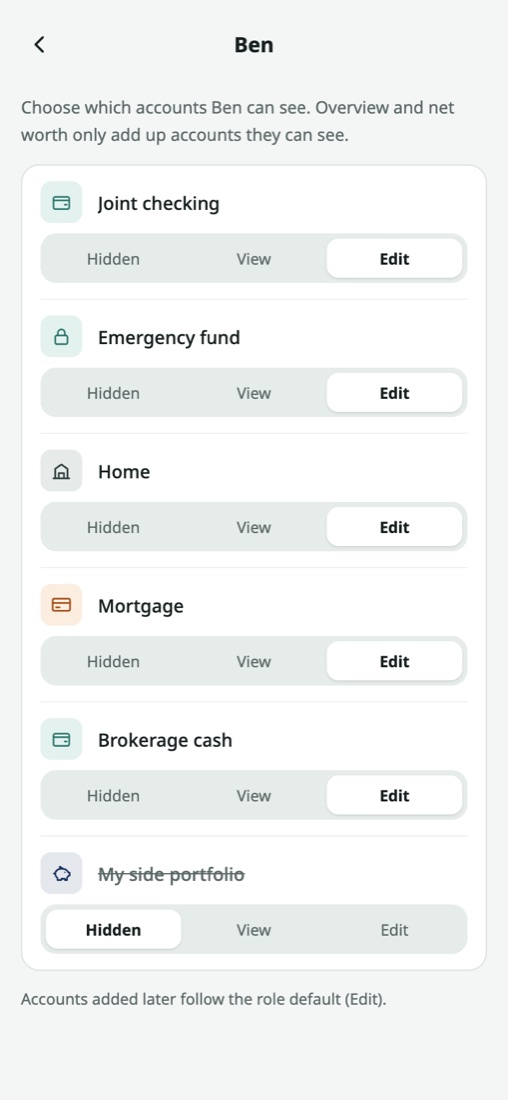
Choose who sees each account
Share the mortgage and family savings with everyone; keep your side portfolio to yourself. Overview totals and net worth history only add up the accounts each person can see, so your private accounts can’t be worked out from the totals.
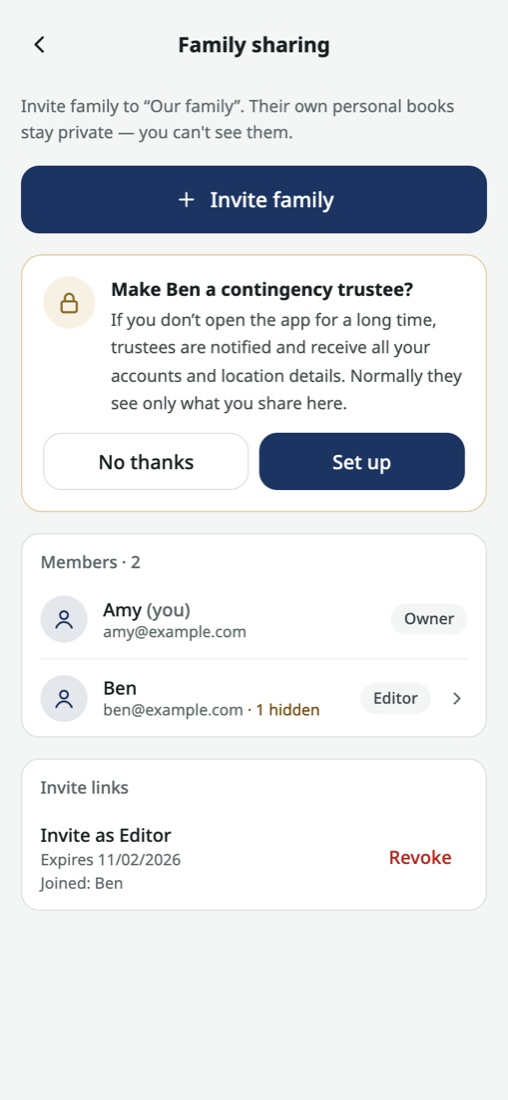
Everyone keeps a personal ledger
Joining a family ledger doesn’t affect your own personal ledger, which others can’t see.
If something happens to you
With the Dead Man’s Switch on, if you stop opening the app for a while, the ledgers you choose — and where each account lives — are handed to the family members you trust. Until then, they only see what you share.
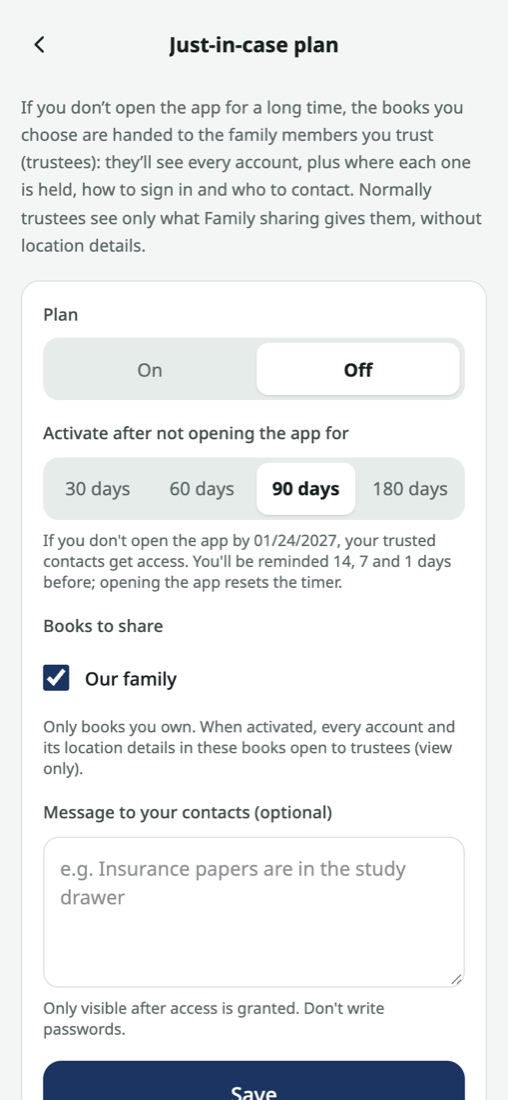
Family sharing, per-account visibility and the Dead Man’s Switch are premium features — currently free for 3 months when you refer 2 friends.
Frequently asked questions
What if my partner doesn’t want to track money?
HoldingsNest doesn’t need every expense — you only update balances when they change, and stock prices update daily. You keep it current; your partner can simply look as a viewer.
Should our parents join too?
You can share just some accounts with them. Many people share the accounts family would need to handle in an emergency — mortgage, insurance, savings — with parents or siblings.
What happens to the data if we split up?
The owner can remove a member at any time, and they lose access to that ledger immediately; members can also leave on their own. Everyone’s personal ledger is unaffected.
Can I start on my own?
Yes. Net worth tracking, automatic prices, cost basis and returns, and loan amortization all work without inviting anyone.
To learn more about why the Dead Man’s Switch matters, read How to find a loved one’s accounts after they pass away.